*Report taken from official website of Opatija Coffeehouse Debates.
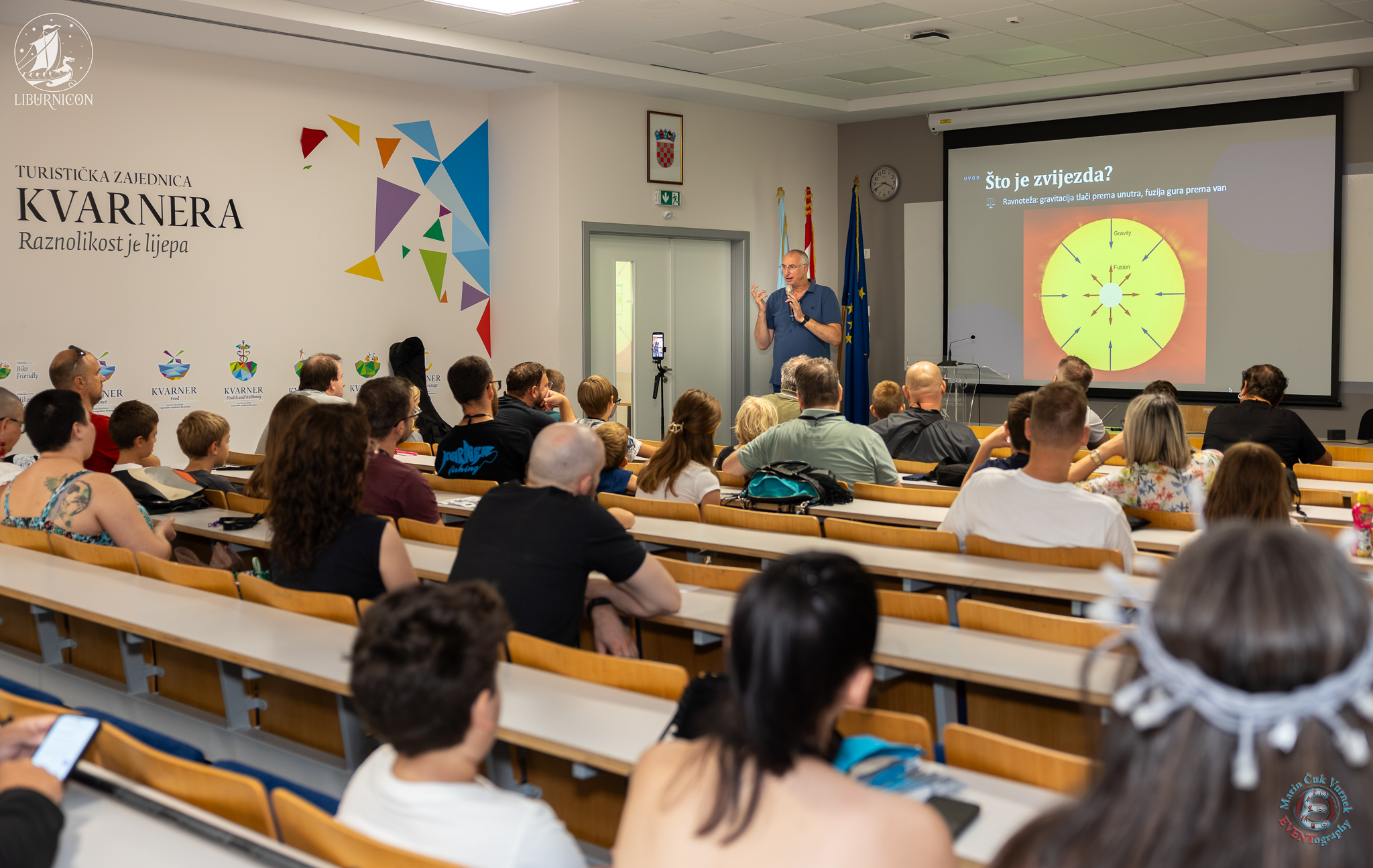
On 4 April, the premises of the Opatija Youth Association “Cultural Front” hosted the second in a series of lectures by young scientists from Opatija, Rijeka and the surrounding area. According to the organizers, the successful project of popularization of science Opatija Coffeehouse Debates was expanded this year with new activities, all with the aim of promoting young scientists and connecting them with the local and regional community. These activities are thus intended not only to draw public attention to the research achievements of young scientists, but also to popularize scientific approach in children and young people and encourage them to engage in science themselves, through formal or non-formal education.
A

lexandar Šušnjar
After the highly attended lecture of young Opatija psychology Sanja Bradić with whom he started this part of the project, the organizers continued the activities with a lecture Aleksandra Šušnjara (from Rijeka), PhD student at the Faculty of Humanities and Social Sciences in Rijeka, which deals with research the connection between the evolutionary origins of our moral intuitions and the complex moral theories that humanity develops. Šušnjar's theoretical approach, in which he uses the results of empirical research of numerous psychologists and with their help evaluates the justification and applicability of various everyday moral intuitions, suggests a model for solving some permanent conflicts that we have in the political community, conflicts that are seemingly impossible to solve because citizens have different moral intuitions or apply different models of reasoning and decision-making.

Lecture in new premises
Šušnjar starts with the idea that some moral or political conflicts between citizens are extremely difficult to resolve precisely because citizens apply different models of thinking, so that some greater and some smaller emphasis is placed on moral intuitions related to the problem around which the conflict arose. Moral intuitions often serve as (more or less reliable) abbreviations in reasoning – when we are faced with a complex problem that requires long-term reflection from us, and we do not have time or other resources to carry it out, moral intuitions jump in, which give us an idea of what the right answer could be, without wasting time and resources on in-depth reflection. Moral intuitions therefore played a significant evolutionary role as they greatly shortened the time it took to make decisions and allowed us to redirect resources to something else.

Philosophers, psychologists and doctors in the audience
The moral intuition that tells us that physically inflicting pain, suffering or harm on other people is something bad, as well as the intuition that incest is something harmful and morally corrupt, has had a very clear positive role in preserving our communities throughout history. However, research shows that, with the advancement of science and technology, many moral intuitions become flawed or not strong enough to adequately perform their function. In other words, with technological and civilization progress, numerous abbreviations in reasoning, which we have developed through our evolutionary past, cease to be reliable and begin to systematically lead us to conclusions that are increasingly difficult to rationally justify. For example, our innate moral aversion to direct physical violence continues to give us sound instructions for proper moral action when we walk down the street and pass with our neighbors, but loses its significance when we are given the opportunity to harm hundreds or thousands of people at a great distance (for example, by pressing a button that activates a guided missile) without directly entering into physical conflict with them. The moral intuition to condemn physical violence thus loses its force and influence when we can do harm to others without ever seeing them, on another continent, simply by pressing a button on the control panel – these are conditions for which our evolutionary past has not prepared us, as this form of harm has only been available for the last hundred years. Evolutionary psychology allows us to discern the evolutionary past of our moral intuitions, question their applicability to today's context, and determine whether (and which) of our moral intuitions are reliable guides when solving a specific problem.
The lecture was followed by a long and high-quality discussion, and Thirty of the participants asked a number of intriguing questions, comments and supplements to the lecturer, but also to others in the audience, so that the rooms in M. Tita Street 42 were crawling with discussion until the late evening. The organizers expressed their enthusiasm for attendance and the quality of lectures and discussions, and announced that at the end of April they plan to hold and the third lecture within this part of the project – a lecture by a young dentist dr.sc. Petra Tariba Knežević (from Ičići), a postdoctoral researcher from the Faculty of Medicine in Rijeka, who will talk about bruxism, the increasingly widespread appearance of teeth grinding caused by stress, anxiety and nervousness, which can have extremely harmful consequences for dental health.
Finally, the organisers stressed that they would also start meetings of the new reading group at the end of April. Reading groups on books by renowned French economist Tomas Piketty and British biologist Richard Dawkins have been held so far as part of the Opatija Coffeehouse Debates project, and in 2018 the book “Practical Ethics” by American philosopher Peter Singer will be processed. The reading group, like all activities within the project, is open to all interested parties, and does not require any special prior knowledge or competencies.