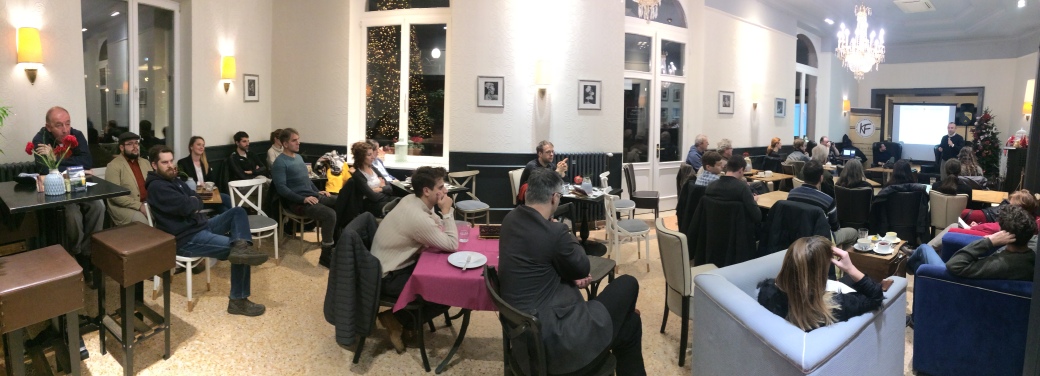
The last panel discussion of the project Opatija Coffeehouse Debates was held on November 28th in Café Continental. In a pleasant and relaxed atmosphere, about forty participants discussed populism, a phenomenon that is increasingly represented in the world, but also in Croatia.

Panellists Berto Šalaj and Nebojša Zelič
The rise of populist parties was clearly illustrated by the first panellist, dr.sc. Berto Šalaj, Associate Professor with the Faculty of Political Science in Zagreb and author The Good, the Bad, the Ugly: Populism in Croatia’. Namely, Šalaj made a table that includes the current ranking of parties around which there is a consensus among political scientists that they can be characterized as populist, and showed that populist parties are extremely good in many EU countries, and in many they are also in power or form part of the ruling coalition (such as the Czech Republic, Italy or Greece). It's interesting, Shalaj points out, how Populists prefer to coalition with other populists, even when they are at the other end of the political spectrum. than with traditional political parties that are closer to them in their worldview (for example, Syriza prefers to coalition with the radical-right populist Independent Greeks party rather than with traditional socialist and social-democratic parties). The cause of this Shalai sees, among other things, deeply in the ideology of populism, which as one of the basic assumptions has the thesis of dividing society into idealized ‘people’ and corrupt ‘elite’(If it's left-wing populism) or ‘minorities’ (This is right-wing populism.) Traditional parties are seen as the cause of democratic deficits. where the interests of the people are neglected or betrayed, while laws and public policies serve the interests of the elites or minority groups. In this context, populism can play a multifaceted role and can be evaluated as good, bad or evil: Populism is good because it highlights democratic deficits and the big problems that exist in traditional politics, It's bad because it often ends up in some form of illiberal democracy., in which the excessive emphasis on the will of the people forgets the fundamental human and civil rights that stand (or at least should stand) outside the reach of the popular will, and It is evil when it is disfigured into neo-fascism and authoritarianism.

Great audience interest and quality discussion
Second panelist, dr.sc. Nebojša Zelič, assistant professor with the Faculty of Humanities and Social Sciences in Rijeka, warned that the term ‘populism’ is often used to Discrediting Political Opponents without directly discussing the content of their program. He pointed out how There is a big difference between left-wing populism., which introduces a vertical distinction between the ‘evil and networked elite’ and the people, the Right Populism, which is based on a horizontal distinction between peoples and (ethnic, religious, sexual, political, racial) minorities, those who are not considered to be part of the people. Left-wing populism is thus based on socio-economic issues, while right-wing populism puts cultural-identity issues at the forefront.According to Zelić, The main problem of populism is not anti-elitism, but the advocacy of the idea that the people cannot make mistakes and that there should be no boundaries in the sphere of its decision-making. Finally, he foxed on increasingly frequent (harmful) attempts to characterize any anti-migration speech as populism or racism/neofascism. Of course, among the opponents of migration there are representatives of these, but it is wrong to automatically reject any discussion on these topics because such behavior only leads to an even greater polarization of society. For example, he believes that numerous quality (or at least reasonable) socio-economic public policies proposed by Marine Le Pen and her National Front party are overshadowed because only her anti-immigrant attitudes are discussed in public, without looking at some relevant economic arguments (for example, that openness to immigration contributes to lowering the minimum wage), but the party's policies are quickly dismissed as racist or populist.
Organizers from the Association “Cultural Front”, Amadria Park Hotel Opatija the Rijeka the Department of Philosophy thanked all the participants and visitors, but also the City of Opatija i the Primorje - Gorski Kotar County They have been financially supporting the maintenance of the project for years.
*Report taken from official website of the “Coffeehouse Debates Abbey” project