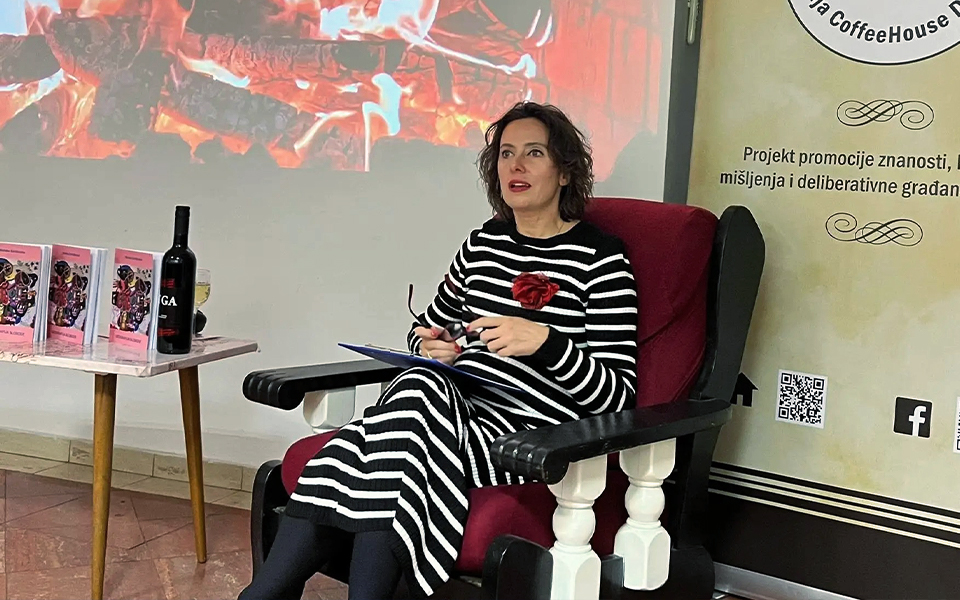
This year's first lecture by young scientists as part of the Opatija Coffeehouse Debates project attracted a large number of interested listeners who wanted to learn more about critical thinking, but also a lot to share with others. Last Tuesday, 26 February, some forty participants, in the pleasant and stimulating atmosphere of the Cultural Front Association, had the opportunity to find out what critical thinking is, why it is important, but also how Croatia stands related to education for critical thinking.

The lecture opened Iva Magaš, PhD student the Study “Philosophy and modernity” at the Faculty of Humanities and Social Sciences in Rijeka, which produces a dissertation specifically related to critical thinking. Magaš pointed out how Critical thinking has a clear goal., which is (in theoretical contact) the creation of a justified and true belief, i.e. (in practical terms) justified and effective action. However, the meaning of this term has been quite distorted in recent decades, when in the perception of the public it becomes a universal remedy for all problems in education, although different actors understand and use it in different ways. She figured out how it was Critical thinking like most sports – if we want to practice it well, we need to train and develop certain virtues and abilities who are attached to him.

Sara Sušanj, a graduate student of pedagogy and philosophy, presented more about these abilities, as well as the educational practices they develop. Sušanj makes a graduate thesis in pedagogy in which she studies how critical thinking is encouraged at the faculty level, and presented the results of this research to interested participants. Surveying students, she noticed a gap between students who generally do not believe that through classes and other faculty activities they are adequately encouraged to think critically, and teachers and professors who believe that they are successful in promoting critical thinking in students. Sušanj also presented the comparative results of several large studies that indicate that Croatian students are extremely poor in terms of critical thinking skills, while those in successful and advanced countries regularly occupy leading positions on the rankings that monitor the abilities of students, as well as the quality of teaching of their teachers and professors.
Interesting presentations were followed by a long and inspiring discussion, which confirmed that the lecturers managed to say a lot about the topic at the same time, but also to leave room for questions, discussion and comments. Participants thus disagreed on the main actor responsible for critical thinking (individual or state, i.e. its education system), as well as on whether virtues (such as openness and tolerance) or ability (such as reasoning or analysis of arguments) are more important for critical thinking. However, these disagreements and the long and positive discussion that succeeded showed not only great interest, but also enviable knowledge of many participants, among whom they stood out students and staff of the Eugen Kumičić Gymnasium Opatija, as well as Many young scientists from Opatija, Rijeka and the surrounding area, who came to support their colleagues and learn something new with them.
Organizers from the Association “Cultural Front” announced new lectures by young scientists, as well as panel discussions that await us in Opatija's famous Café Continental.
*Report taken from official website of the “Coffeehouse Debates Abbey” project