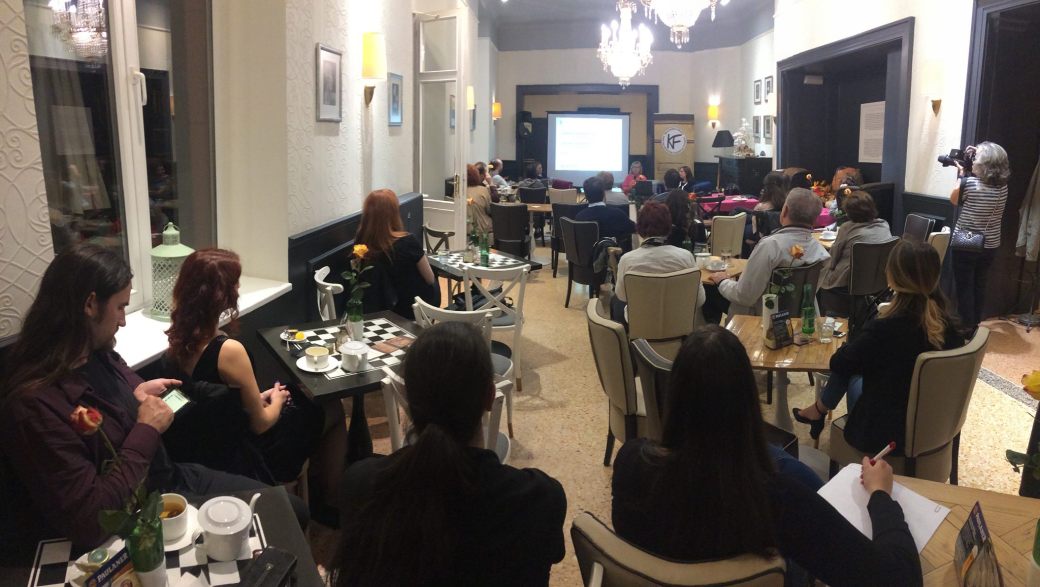
The new academic year of the panel discussion in Café Continental opened on October 9, 2018 with a discussion on history, mechanisms, side effects and contraindications of the vaccine. Organizers from the Association Kulturni front, Amadria Park Hotel and the Department of Philosophy of the Faculty of Humanities and Social Sciences in Rijeka decided to dedicate the twentieth panel discussion to the topic of Highly relevant in South-Eastern Europe since the emergence of infectious diseases in the countries of the region, but also in the south of Croatia, which we have not seen for decades.

From the presentation by Ivana Munitić
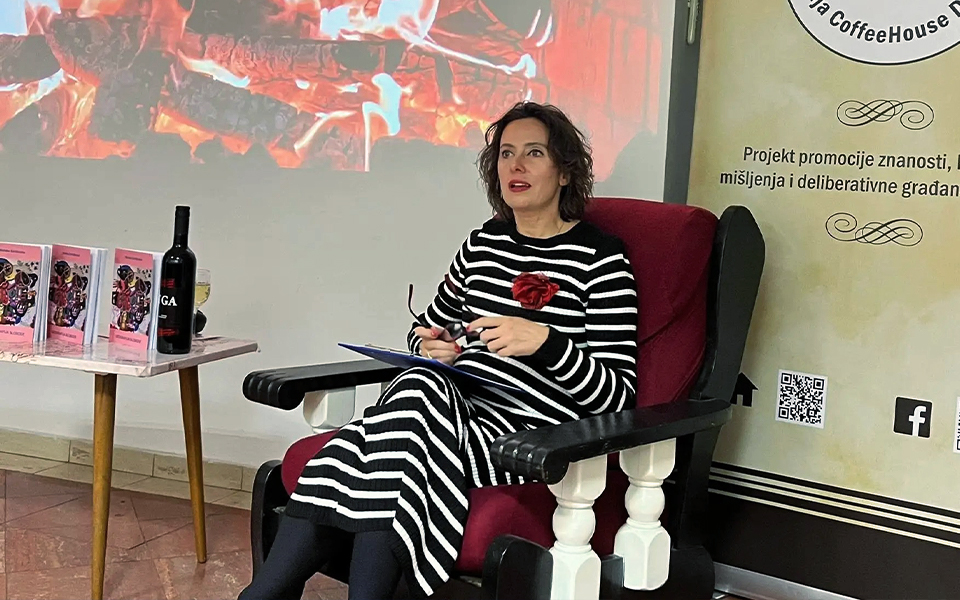
Forty interested listeners first had the opportunity to listen to an extremely interesting and detailed presentation Assistant Professor Ivana Munitić from the Department of Biotechnology University of Rijeka, who holds a PhD in immunology from the University of René Descartes in Paris and currently works as the Head of the Laboratory for Molecular Immunology. Munitić explained that vaccines are not a new form of disease prevention since similar methods have been used for centuries to protect against infectious diseases. Somewhat more modern forms occur at the end of the 18th century, when the British doctor Edward Jenner observed that dairies often suffering from non-particularly dangerous cowpox rarely or almost never suffer from far more dangerous and deadly smallpox, of which Nearly half a million people died at that time each year.. Jenner was the first to deliberately infect volunteers with cowpox in order to gain immunity to a more dangerous version of the disease, and this practice was further developed so that today we have vaccines that are far more harmless, but also far more successful than those of the late 18th century. Of course, the munitic points out, the immunity acquired after the real disease has been overcome is somewhat stronger and longer lasting than in the case of vaccination, but vaccination avoids the risk of unpleasant consequences that cause the disease to be avoided, Re-vaccination is always possible to strengthen immunity. She paid particular attention to the issue of vaccination against Measles, pointing out that it is a highly contagious disease which, although significantly less dangerous and deadly today than a hundred years ago, still poses a great danger to young children and immunocompromised people. Because those most affected by the disease often and cannot be vaccinated against it (such as children between half a year of age, when they stop being protected by the immunity acquired from the mother, and a year, when a vaccine can be given), it is extremely important that high vaccination coverage of citizens is maintained in the community, as this is the only way to protect those who cannot be vaccinated.
Munitić dedicated a special part of the presentation to answering the myths of anti-vaccine opponents gathered in the anti-vax movement, who often refer to Andrew Wakefield's 20-year-old article, which shows no link between autism and vaccination against measles. Munitic points out that this Article long withdrawn due to wrong methodology, but that dozens of studies were conducted to confirm or disprove his hypthesis, but none showed any association between autism and vaccination. What's more, it was revealed that Wakefield's research was directed and funded by law firms that had a direct interest in this conclusion, which ultimately led to Wakefield being stripped of his doctor's license.

Doctors Lakošeljac and Gastović-Bebić
Dr. Danijela Lakošeljac i Dorotea Gastović-Bebić withthe Epidemiological Department at the Teaching Institute of Public Health of the Primorje-Gorski Kotar County pointed out that vaccines do not only serve to prevent getting the disease, but can also help to make the symptoms and consequences of the disease significantly harmless(even if it gets sick), i.e. prevent disability and death from a number of infectious diseases. Nowadays, vaccines, the panelists point out, work from dead or substantially weakened disease agents in order for our immune system to adapt to the threat and could be significantly easier to deal with when threatened by living and active agents. Moreover, vaccines that do not contain entire cells of the causative agent, but only their components, are increasingly used. Vaccination thus protects not only ourselves but the entire community, since the disease cannot spread in conditions when there is a large number (over 90% citizens, i.e. more than 95% in the case of highly contagious diseases such as measles) vaccinated citizens. The panelists explained the complex process of reporting side effects and contraindications, and pointed out how vaccines are tested repeatedly, on thousands of different subjects, before they are allowed to be used commercially. Looking at the data on the number of vaccinated persons in Croatia and the Primorje-Gorski Kotar County, they concluded that Vaccine coverage lower than it should be to maintain group immunity, but also pointed out that the bright point is represented by primary schools since, although many children are not adequately vaccinated before going to school, this is corrected in earlier primary school grades.
After almost two hours of discussion, the organizers thanked everyone for their extremely high quality and inclusive contribution, but also announced the following events as part of the Opatija Coffeehouse Debates project. It's a panel discussion about Brexit which will be maintained October 25 in Café Continental, in which they will participate as panelists Professor Thom Brooks of Durham University (United Kingdom) and Professor Dejan Jović from the Faculty of Political Science in Zagreb.
*Report taken from official website of the “Coffeehouse Debates Abbey” project